
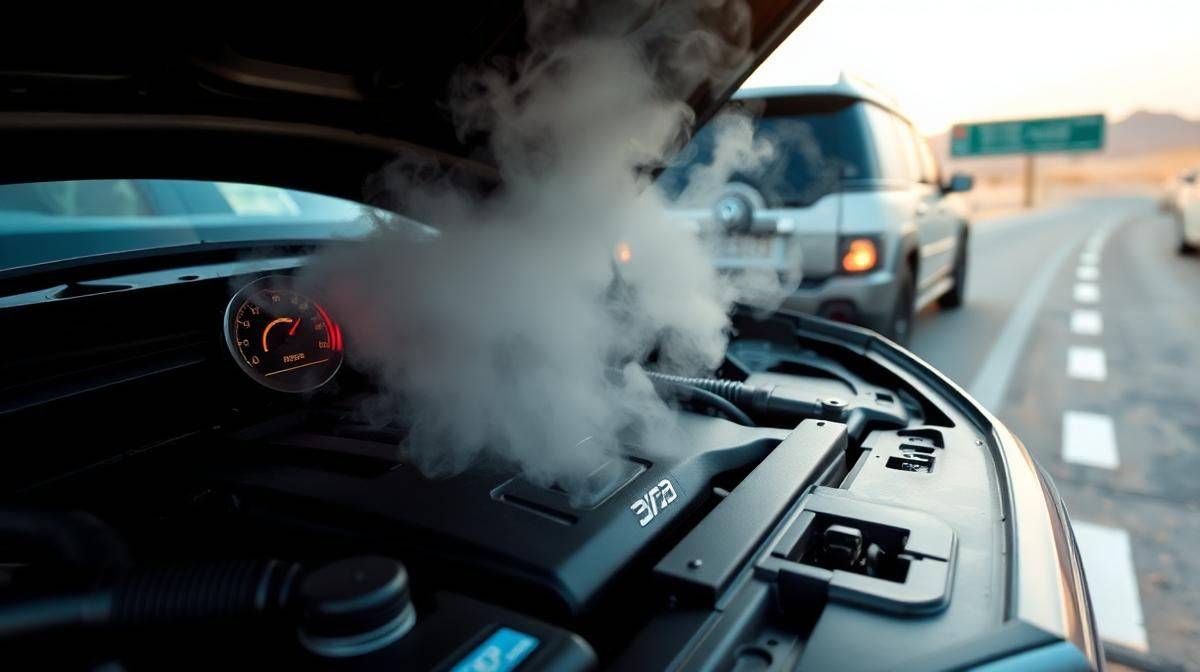
Car Engine Overheating in Dubai: Causes, Repair Cost & Prevention Guide 2026
Car engine overheating in Dubai costs AED 200–15,000 to repair depending on the root cause — from a simple AED 350 thermostat replacement to a catastrophic AED 15,000 head gasket job that only happens when drivers ignore the warning signs. In a city where ambient temperatures hit 50°C and traffic barely moves, your cooling system works harder than anywhere else on Earth.
In 15 years of diagnosing overheating vehicles in Dubai, I've seen the same pattern hundreds of times: a driver notices the temperature gauge creeping up, assumes it's "just the heat," and keeps driving. Three weeks later, they're facing a warped cylinder head and a repair bill that exceeds the value of the car. This guide gives you the exact warning signs, realistic Dubai repair costs, a step-by-step emergency response, and the preventive maintenance schedule that stops overheating before it starts.
Engine Overheating Dubai: Key Numbers
10 Warning Signs Your Car Is Overheating
Overheating rarely happens without warning. These symptoms escalate rapidly in Dubai's climate — what might be a slow leak losing 50ml/week in London becomes a full system failure in three weeks here because the cooling system is already operating at near-maximum capacity. Act on any of these immediately:
Engine Overheating Warning Signs — Pull Over Immediately
- Temperature gauge rising above the middle mark — even briefly in traffic
- Temperature warning light (red thermometer icon) illuminating on the dashboard
- Steam or white smoke coming from under the bonnet
- Sweet smell (ethylene glycol) inside the cabin or near the front of the car
- Coolant puddle under the vehicle after parking (green, pink, or orange fluid)
- Heater blowing cold air when set to hot — indicates low coolant or circulation failure
- Engine power suddenly drops or enters "limp mode" to protect from heat damage
- Gurgling or bubbling sounds from the dashboard area (air in the heater core)
- Coolant level dropping between services without visible leaks (internal leak)
- White residue or crystallisation around radiator cap, hoses, or expansion tank
The Most Dangerous Sign: Heater Blowing Cold
If your cabin heater suddenly blows cold air when set to hot, your coolant level is critically low or circulation has stopped. Most drivers don't connect "heater not working" with "engine about to overheat" — but the heater core is fed by the same coolant circuit. When there isn't enough coolant to reach the heater core, there isn't enough to cool the engine either. You may have less than 10 minutes before the temperature gauge enters the red zone. Pull over and check your coolant immediately.
Why Cars Overheat More in Dubai Than Anywhere Else
Your car's cooling system was designed and tested in Germany, Japan, or the UK — countries where "extreme heat" means 35°C. In Dubai, the cooling system faces a perfect storm of conditions that no manufacturer fully accounts for:
| Dubai Factor | Impact on Cooling System | Severity |
|---|---|---|
| Ambient temperature 45–52°C | Radiator can only reject heat into air that's already 50°C — cooling efficiency drops 40% | Critical |
| Stop-start traffic (SZR, Al Khail) | Zero ram airflow — radiator fan is sole cooling source at idle | Critical |
| AC compressor running 10 months/year | Adds 3–5°C engine load; condenser blocks airflow to radiator | High |
| Sand and dust accumulation | Clogs radiator fins, reducing surface area for heat exchange | High |
| Hot road surface (70°C+) | Radiates heat upward into engine bay, raising underbody temperatures | Moderate |
| Coolant degradation accelerated | Anti-corrosion additives deplete 2× faster; internal corrosion begins | Moderate |
The combination of these factors means a cooling system operating at 85% efficiency in Europe is operating at 50–60% efficiency in Dubai — and it only takes one additional weak point (aging thermostat, partially blocked radiator, worn water pump) to push the system past its limit. This is why Dubai summer car care must include a dedicated cooling system inspection every year.
7 Most Common Causes of Engine Overheating in Dubai
Based on our workshop data from 500+ overheating repairs in Dubai, these are the root causes ranked by frequency. Notice that the most expensive cause (head gasket) is almost always the result of ignoring one of the cheaper causes above it:
| # | Cause | Why It Happens in Dubai | Repair Cost | Frequency |
|---|---|---|---|---|
| 1 | Coolant leak (hose, clamp, expansion tank) | Rubber degrades faster in extreme heat; plastic tanks become brittle | AED 200–800 | 35% |
| 2 | Thermostat failure (stuck closed) | Wax element fatigues from constant thermal cycling | AED 350–800 | 25% |
| 3 | Radiator fan failure (motor or relay) | Fan runs nearly 24/7 in Dubai; motor bearings wear out | AED 400–1,500 | 15% |
| 4 | Water pump failure | Seal and bearing failure from continuous high-speed operation | AED 600–2,500 | 10% |
| 5 | Blocked or corroded radiator | Sand clogs external fins; degraded coolant corrodes internal passages | AED 800–3,500 | 8% |
| 6 | Coolant degradation (never changed) | Additives deplete 2× faster; coolant becomes acidic and corrosive | AED 250–500 | 5% |
| 7 | Head gasket failure | Result of prolonged overheating — the consequence, not the cause | AED 3,500–15,000 | 2% |
The AED 350 Fix That Prevents a AED 15,000 Disaster
A thermostat costs AED 350–800 to replace. A head gasket costs AED 3,500–15,000. The connection? A stuck thermostat prevents coolant from reaching the radiator, causing the engine to overheat. If caught during routine maintenance, it's a 2-hour job. If ignored until the head gasket blows, it's a 3–5 day engine-out repair. 98% of head gasket failures we see started as a simple cooling system fault that was ignored. The maths couldn't be clearer.
Vehicle-Specific Overheating Issues in Dubai
Every vehicle has its own cooling system weak point. Knowing your car's specific vulnerability lets you target preventive maintenance where it matters most:
Range Rover Sport / Vogue — Plastic Coolant Pipe Failures
The most common overheating cause in Range Rover models (2014–2022) is plastic coolant pipe and thermostat housing failure. Land Rover used plastic components in the cooling system that become brittle after 3–5 years of Dubai heat exposure. The thermostat housing develops hairline cracks that leak slowly — often only visible when the system is pressurised. Cost to replace: AED 800–2,000 for thermostat housing and coolant pipes. We recommend replacing all plastic coolant components preventatively at 80,000 km for Dubai-based Range Rovers.
BMW X5/X6 (N63 Twin-Turbo V8) — Marginal Cooling Capacity
BMW's N63 engine (fitted to X5 50i, X6 50i, 750i) places the turbochargers in the "hot-vee" configuration — between the cylinder banks. This creates enormous heat concentration that the cooling system struggles to manage in Dubai temperatures. Common failures include coolant transfer pipe leaks (AED 1,500–3,000), electric water pump failure (AED 1,200–2,000), and valley pan gasket leaks (AED 2,000–4,000).BMW N63 owners in Dubai should have a cooling system pressure test every 12 months.
Nissan Patrol (VK56 V8) — Water Pump Pattern Failure
The Nissan Patrol's VK56DE V8 has a known water pump failure pattern between 80,000–120,000 km. The pump bearing fails, initially causing a faint whining noise at idle that progresses to a full coolant leak. In Dubai, this failure accelerates because the pump runs at maximum capacity nearly year-round. Replacement cost: AED 800–1,800. We recommend preventative replacement at 80,000 km — it's a fraction of the cost of the engine damage that follows a pump failure on Sheikh Zayed Road in July.
Mercedes GLE/GLC — Auxiliary Water Pump & Thermostat
Mercedes GLE and GLC models use an auxiliary electric water pump that continues circulating coolant after the engine is switched off — critical in Dubai where "heat soak" can damage turbochargers and head gaskets post-shutdown. When this auxiliary pump fails (common at 60,000–100,000 km), heat soak damage accumulates silently. The main thermostat is also a frequent failure point. Auxiliary pump: AED 600–1,200. Thermostat: AED 500–900.Both should be inspected during every major service.
Engine Overheating Repair Cost in Dubai 2026
Here's what overheating repairs cost at a specialist independent workshop in Dubai. Dealer prices are typically 50–80% higher for the identical repair. Every repair below includes a full cooling system pressure test to confirm the root cause before work begins.
Overheating Repair Pricing Dubai 2026
| Service | Price (AED) |
|---|---|
Coolant Pressure Test & Leak Detection
| AED 200–400 |
Thermostat Replacement
| AED 350–800 |
Radiator Fan Motor Replacement
| AED 400–1,500 |
Water Pump Replacement
| AED 600–2,500 |
Radiator Replacement
| AED 800–3,500 |
Head Gasket Repair
| AED 3,500–15,000 |
Compare these to dealer pricing: a Range Rover thermostat housing replacement at the Land Rover dealer costs AED 1,800–2,500. At BRITFIX using OEM-equivalent parts: AED 800–1,200. Same parts. Same repair. Same warranty protection under UAE consumer law. See our full car repair cost guide for more pricing comparisons.
How to Prevent Engine Overheating in Dubai: 10-Point Checklist
Prevention is 10× cheaper than repair. This is the exact cooling system maintenance schedule we recommend for every vehicle operating in Dubai's climate. Follow this and overheating becomes virtually impossible:
Dubai Cooling System Maintenance Checklist
- Check coolant level weekly during summer months (May–October)
- Replace coolant every 40,000 km or 2 years in Dubai (not factory 80,000 km)
- Inspect radiator fins for sand/debris blockage every 20,000 km
- Test thermostat operation during every major service
- Replace water pump preventatively at 80,000–100,000 km (before it fails)
- Check radiator fan operation — both fans should run at idle when AC is on
- Inspect all coolant hoses for cracks, swelling, or soft spots annually
- Never mix coolant types — always use manufacturer-specified coolant
- Ensure radiator cap holds correct pressure (1.1–1.4 bar for most vehicles)
- Have a cooling system pressure test every 12 months as preventive maintenance
The Dubai Coolant Rule: 40,000 km, Not 80,000 km
Every manufacturer specifies coolant change intervals for temperate European conditions — typically 80,000–160,000 km. In Dubai, halve the interval. Change coolant every 40,000 km or 2 years. At BRITFIX, a complete coolant flush with OEM-specification antifreeze costs AED 250–500. The radiator replacement that follows neglected coolant costs AED 800–3,500. The head gasket that follows a corroded radiator costs AED 3,500–15,000. Prevention isn't just cheaper — it's the only sensible approach.
Related Services That Prevent Overheating
Engine cooling doesn't exist in isolation. These related services directly impact whether your car overheats in Dubai:
- Engine oil change Dubai — Degraded oil increases engine friction and heat generation. In Dubai, change engine oil every 5,000–7,500 km to reduce thermal load on the cooling system.
- AC repair Dubai — A failing AC compressor draws more engine power, increasing heat output. A refrigerant leak forces the compressor to work harder, adding thermal stress.
- Coolant flush — The single most effective preventative job in Dubai. Degraded coolant loses its boiling-point margin long before it looks dirty; a flush every two years keeps the margin where it should be.
- Computer diagnostics — Modern cars have multiple coolant temperature sensors. A diagnostic scan reveals cooling system fault codes before they cause an overheating event.
- Battery replacement Dubai — A weak battery causes the alternator to work harder, generating additional engine bay heat. Electric water pump vehicles (BMW, Mercedes) need full battery voltage to maintain coolant flow.
- Engine repair Dubai — If overheating has already caused damage, our full engine repair guide covers head gasket replacement, cylinder head skimming, and engine rebuild options with Dubai pricing.
Car Overheating Dubai — Frequently Asked Questions
Reviewed by Mushtaq Ahmad, Workshop Manager, BRITFIX Auto Repair, Al Quoz Dubai.
Related Articles
Car Passing in Dubai: The Complete RTA Vehicle Inspection Guide
Every registered car in Dubai needs an annual technical inspection before the mulkiya can be renewed, and most failures are avoidable. What the RTA test checks, the eight faults that fail most cars, a ten-minute pre-test checklist, and the right order to fix things if you do fail.
Dealer vs Independent Car Service in Dubai: Real 2026 Cost Comparison
Real 2026 dealer-vs-independent price comparison for Dubai: what a major service, brakes and AC work actually cost at each, why your warranty survives leaving the dealer, and the three situations where the dealership is genuinely the right call.
Best Car Garage Near Me in Dubai 2026: Independent Ranking, Pricing & Free Pickup
The definitive 2026 guide to finding the best car garage near you in Dubai. Independent ranking, real dealer-vs-specialist price comparison, 10-point trust checklist, and free pickup across 30+ Dubai communities.