
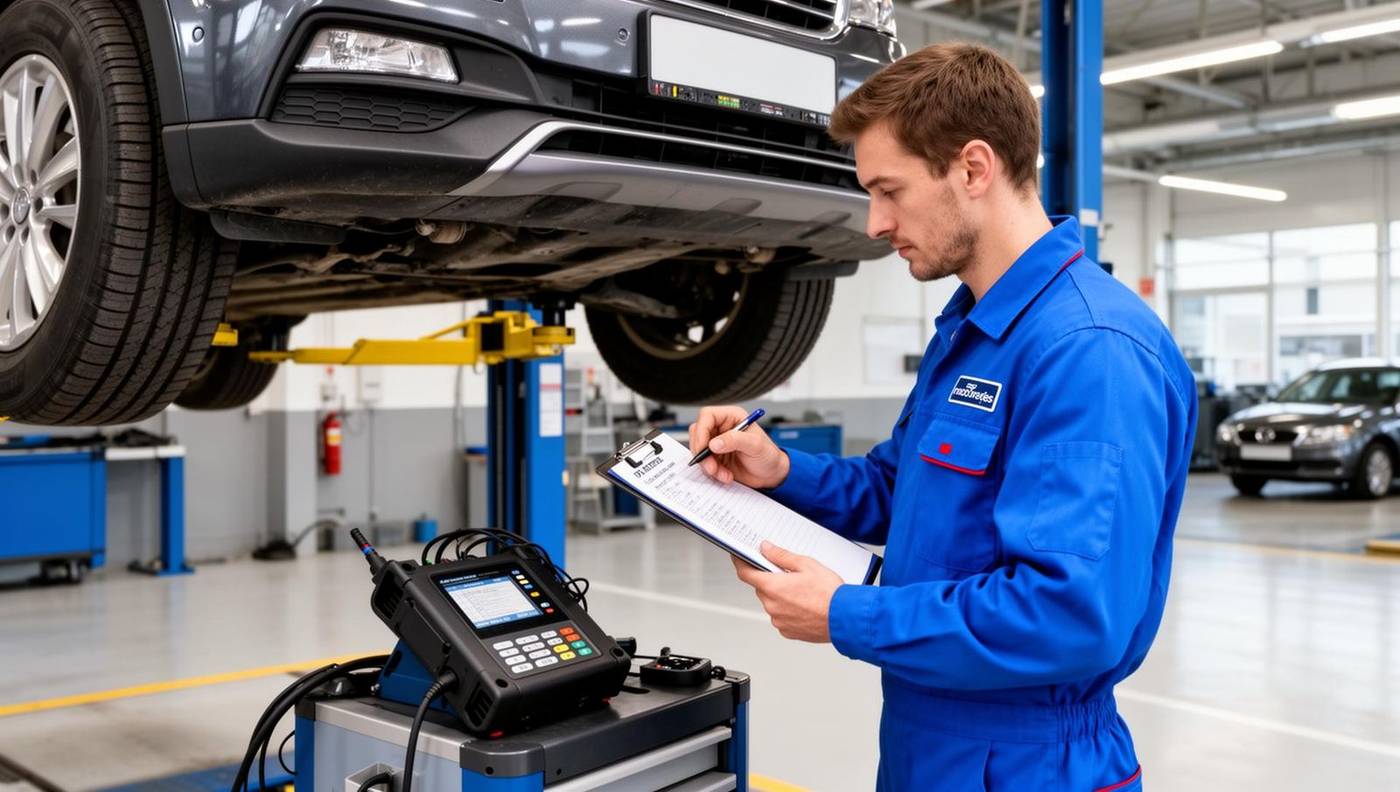
Car Passing in Dubai: The Complete RTA Vehicle Inspection Guide
Every registered car in Dubai has to pass an annual technical inspection before the registration can be renewed. Most people call it "car passing", and most failures are avoidable — the same handful of faults turn up again and again, and nearly all of them can be spotted before you ever drive to the testing centre. This guide covers what is checked, why cars fail, and how to make sure yours passes first time.
The short answer
Book a pre-test check before you go. The test itself is quick and inexpensive, but a failure costs you a second trip, a retest and the repair anyway. Tyres, brakes, lights, suspension and tint account for the overwhelming majority of failures, and every one of them is visible on a lift in under an hour.
Not sure your car will pass?
We run the same checks the testing centre does — brakes, suspension, tyres, lights, leaks and tint — and tell you exactly what would fail before you waste a trip. Free collection anywhere in Dubai.
- No obligation to proceed
- You approve the work
- Free Dubai pickup
What the RTA vehicle inspection actually checks
The technical inspection is a roadworthiness test, not a service. The tester is not interested in whether your oil is fresh — they are checking that the car is safe to be on the road and that it has not been altered beyond what is permitted. In practice the inspection covers these areas:
Brakes
Braking force is measured on a rolling road, side to side and front to rear. Uneven force across an axle fails even when the car stops fine in normal driving.
Suspension and steering
Play in ball joints, track rod ends and bushes, plus damper performance. Knocking over bumps is the symptom you would notice first.
Tyres
Tread depth, uneven wear, sidewall damage and age. In UAE heat an old tyre with legal tread can still be condemned.
Lights and signals
Every bulb, plus headlight aim. A single blown number-plate bulb is enough to fail a car that is otherwise perfect.
Glass and tint
Windscreen cracks and chips in the driver's line of sight, and tint darkness measured against the legal limit.
Emissions and exhaust
Exhaust gas readings and the physical condition of the system. Blowing joints and non-standard exhausts are both fail points.
Leaks and underbody
Oil, coolant and brake fluid leaks, plus corrosion or damage to structural components underneath.
Body and identity
Chassis and engine numbers matching the registration, plus body damage severe enough to be a hazard.
On fees, dates and exact limits
Inspection fees, new-vehicle exemption periods and tint limits are set by the RTA and are revised from time to time. We have deliberately not printed figures here that could be out of date by the time you read this — check the current numbers on the RTA website or app. What we can tell you accurately is the mechanical side: what fails, why, and what it costs to put right.
The eight faults that fail most cars
These are the failures we see most often in the workshop, roughly in order of how frequently they turn up on a fail sheet. Each one is checkable before you go.
Tyres past their limit
Why it fails: Tread below the legal minimum, uneven wear from an alignment fault, cracked sidewalls, or a tyre simply too old for the heat here. UAE summers age rubber faster than the tread wears out, so a tyre with plenty of tread can still be unsafe.
Putting it right: Replace the affected tyres and correct whatever caused uneven wear — usually alignment. See our guide on tyre condition and when age matters. Tyre replacement.
Brake imbalance or worn pads and discs
Why it fails: The rolling road measures each wheel separately. A sticking caliper or a glazed pad shows as an imbalance long before you would feel anything wrong through the pedal.
Putting it right: Pads, discs and caliper servicing as required. Cleaning and regreasing seized slide pins often fixes an imbalance without new parts. Brake pads and discs.
Blown bulbs and headlight aim
Why it fails: The cheapest possible reason to fail. Number-plate lights, a single brake bulb or a headlight aimed too high will all do it, and most owners never notice.
Putting it right: Bulb replacement takes minutes; aim is adjusted on a beam setter. Both are covered in a pre-test check. Auto electrical checks.
Worn suspension components
Why it fails: Perished bushes, worn ball joints and tired dampers. Dubai speed bumps and road-edge grit wear these faster than the mileage suggests, and the tester can feel play you cannot.
Putting it right: Individual components replaced rather than whole assemblies wherever possible — usually far cheaper than the first quote suggests. Suspension repair.
Window tint over the limit
Why it fails: Film applied without checking the legal limit, or tint on the front windscreen where it is not permitted at all. Nothing mechanical is wrong with the car, and it still fails.
Putting it right: Have the tint measured before the test. If it is over, it has to come off — better to find out in a workshop than at the centre.
Oil and fluid leaks
Why it fails: Anything dripping is a fail. Common sources are valve cover gaskets, oil filter housings, sump plugs and power steering lines — all of which start as a smell or a small mark on the driveway.
Putting it right: The leak is traced to its source and the gasket or seal replaced. Catching it here also prevents the bigger failure it would eventually cause. Engine and leak repair.
Cracked or chipped windscreen
Why it fails: Damage in the driver's field of view fails, even when the glass is structurally sound. Small chips spread quickly in the heat cycle between a hot car park and full air conditioning.
Putting it right: A chip can often be filled if caught early; once it has spread across the sight line the screen needs replacing.
Exhaust and emissions faults
Why it fails: A blowing joint, a failed catalytic converter or a non-standard exhaust. Emissions readings also drift out of range when the engine has a misfire or a tired oxygen sensor.
Putting it right: Diagnosis first — an emissions failure is a symptom, and replacing the exhaust when the real fault is a sensor wastes money. Computer diagnostics.
Your pre-test checklist
Ten minutes on your driveway will catch a surprising share of failures. Do this the week before you plan to go:
Check these yourself before booking
- 1Walk around with the engine running and a helper — check every light: headlights on both beams, indicators, hazards, brake lights, reverse and number-plate bulbs.
- 2Look at each tyre for uneven wear across the tread, cracks in the sidewall, and any bulges. Check the pressures while you are there.
- 3Look under the car after it has been parked overnight — any fresh drips of oil, coolant or fluid need investigating before the test.
- 4Check the windscreen for chips or cracks anywhere in front of the driver.
- 5Push down hard on each corner of the car; it should settle in one bounce. Repeated bouncing points at worn dampers.
- 6Listen for knocks over speed bumps at low speed — that is usually suspension bushes or drop links.
- 7Test the horn, the wipers and the washers. All three are checked and all three are cheap to fix.
- 8If your windows are tinted and you did not have it done to a verified legal limit, get it measured before you go.
Bring the right paperwork
Take your registration card (mulkiya), your Emirates ID and valid insurance. If you are returning after a failure, bring the fail sheet — it tells the retester exactly which points to re-check rather than starting over. Clear the boot enough for the spare wheel to be seen if your vehicle carries one.
Failed the test? Here is the order to do things
A fail sheet is not a disaster — it is a specific, itemised list, which is far more useful than a vague warning light. Work through it in this order:
- Read the sheet properly. Each line is a separate failure point. Some are five-minute fixes and some are not, and the sheet does not distinguish between them.
- Get the whole list quoted at once. Fixing items one at a time means multiple retests. A single visit that clears every point is cheaper and faster.
- Ask what caused it, not just what failed. Uneven tyre wear means an alignment fault; brake imbalance often means a sticking caliper. Replacing the symptom without the cause means failing again next year.
- Retest within the allowed window. Centres normally permit a retest within a set period without charging the full fee again, so do not let the repairs drift.
What we do for a pre-test check
We put the car on a lift and go through the same points the centre does: brake condition and balance, suspension play, tyre condition and age, every light, leaks from above and below, exhaust condition, glass and tint. You get a written list of anything that would fail, with prices, and you decide what to do. If nothing needs doing we tell you that too — and you drive to the centre knowing you will pass.
Buying a used car? Do this first
A car being sold with a fresh pass certificate has cleared a safety test — it has not been assessed for mechanical condition, accident history or upcoming costs. The inspection says the brakes work; it says nothing about a gearbox that shudders or a service history with a two-year gap in it. If you are buying, a pre-purchase inspection answers the questions the passing test does not, and our Dubai repair cost guide shows what those problems cost to put right if you buy anyway.
Frequently Asked Questions
What is car passing in Dubai?
"Car passing" is the everyday name for the annual technical inspection your vehicle must pass before its registration (mulkiya) can be renewed. A tester checks the roadworthy essentials — brakes, suspension, steering, lights, tyres, emissions, glass and body condition — and issues a pass or a fail sheet listing what needs putting right.
How often does a car need passing in Dubai?
The test is tied to your registration renewal, so for most private cars it is an annual event. Brand-new vehicles are exempt for an initial period after first registration. Because exemption windows and requirements are set by the RTA and do change, confirm your own renewal date on the RTA app or website rather than relying on a rule of thumb.
Where can I get my car passed in Dubai?
RTA-approved testing centres run across the emirate — Tasjeel, Shamil, Wasel and Mumayaz among them, several attached to ENOC and EPPCO stations. Any approved centre can issue the certificate; they do not repair cars, so if you fail you will need a garage to put the faults right before you return.
What are the most common reasons cars fail the test in Dubai?
In our workshop the repeat offenders are tyres (age, uneven wear or damage), brakes, lights and bulbs, worn suspension components, window tint over the legal limit, oil and fluid leaks, cracked windscreens, and exhaust or emissions faults. Almost all of them are visible or measurable before you ever drive to the centre.
What happens if my car fails the passing test?
You receive a sheet listing each failure point. Repair those items, then return for a retest — centres normally allow a retest within a set window without paying the full fee again. Bring the fail sheet with you, both to the garage and back to the centre, because it tells the retester exactly what to re-check.
Can a garage check my car before the test?
Yes, and it is the single cheapest way to avoid a wasted trip. A pre-test inspection covers the same points the centre checks, so anything that would fail is found and quoted before you go. BRITFIX runs this check with free collection and delivery across Dubai — you do not need to bring the car to us.
Does window tint cause a failed test?
It is one of the most common non-mechanical failures. Dubai limits how dark the tint on a private vehicle may be and does not permit tint on the front windscreen. Aftermarket film applied without checking the legal limit is a frequent cause of an otherwise healthy car being turned away, so have it measured before the test rather than after.
Will modifications fail the inspection?
Non-standard exhausts, suspension changes, lighting changes and body modifications are all checked, and unapproved changes are a common fail. Some modifications can be formally approved; others must be reversed before the test. If your car is modified, ask a garage to review it against the current rules before you book the inspection.
Pass first time
A pre-test check costs a fraction of a failed inspection plus a wasted morning. Tell us your car and when your registration is due — we'll collect it, check every point the centre checks, and hand it back ready to pass.
- No obligation to proceed
- You approve the work
- Free Dubai pickup
Reviewed by Mushtaq Ahmad, Workshop Manager, BRITFIX Auto Repair, Al Quoz Dubai.
Related Articles

Dealer vs Independent Car Service in Dubai: Real 2026 Cost Comparison
Real 2026 dealer-vs-independent price comparison for Dubai: what a major service, brakes and AC work actually cost at each, why your warranty survives leaving the dealer, and the three situations where the dealership is genuinely the right call.
Best Car Garage Near Me in Dubai 2026: Independent Ranking, Pricing & Free Pickup
The definitive 2026 guide to finding the best car garage near you in Dubai. Independent ranking, real dealer-vs-specialist price comparison, 10-point trust checklist, and free pickup across 30+ Dubai communities.
Full Car Service Dubai 2026: Cost, What's Included & How to Save 50%
Complete 2026 guide to full car service in Dubai with transparent pricing for every vehicle type, a 25-point service checklist, dealer vs independent garage comparison showing 30-50% savings, Dubai-specific service intervals, and free pickup & delivery.